
With years of profound expertise in the LED lighting industry, we recognize that the quality of LED lights extends beyond brightness, color temperature, and lifespan to encompass “invisible” performance metrics. Among these, “flicker” is a critical issue that cannot be overlooked; it not only impacts the end-user’s visual experience but also directly undermines business reputation and market competitiveness.
To address this challenge, we present an in-depth analysis of LED flicker, covering three core dimensions: technical principles, potential risks, and our targeted solutions.
I. What is LED flicker? — Understanding its nature at the source
LED flicker can be conceptualized as the “breathing” of an LED light source.While the light appears constantly illuminated to the naked eye, it is actually cycling repeatedly between “on” and “off” states. If this switching speed exceeds the limits of human perception (typically over 100 times per second), no flicker is detectable.
However, if the quality of the driver power supply is poor, disrupting the regularity of the “breathing” rhythm or lowering the frequency excessively, it will lead to visible flicker or the “ripple” effect which can be captured by a common camera.(Due to advancements in imaging technology, most modern mobile phones cannot capture the water-ripple effect of the lighting fixtures).
1.Quality of the LED Driver — The Core Factor
LEDs operate on direct current (DC), while household power supply is alternating current (AC). The driver serves to convert AC into stable DC. Its quality directly determines whether flickering occurs and how severe it is.
Substandard power supplies: Insufficient filtering capacitance or a rudimentary circuit design leads to wave-like fluctuations in output current, directly causing synchronous “flickering” or “jumping” of the light.
To cut costs and boost efficiency, many mainstream non-isolated or isolated constant-current LED drivers on the market adopt Pulse Width Modulation (PWM) for dimming or constant-current control. When the PWM frequency is low (e.g., below 1000 Hz) and current ripple is poorly managed, the LED chip switches on and off rapidly at frequencies either visible or invisible to the naked eye, resulting in detectable flicker
2.Input voltage mismatch
If a light fixture rated for 220V is used in an area with highly unstable voltage (e.g., below 180V or above 240V)—beyond the driver’s voltage regulation range—flickering may occur.
II. The Dangers of Flicker: Beyond Mere “Eye Strain”

Numerous clients hold the misconception that flicker invisible to the naked eye is harmless. In fact, the hazards of flicker go far beyond simple visual fatigue:
1. Visual Fatigue: Prolonged exposure to flickering light causes constant contraction and relaxation of the pupillary sphincter, which readily leads to dry eyes and headaches.
2. Photosensitive Epilepsy Risk: For light-sensitive individuals, intense flicker can induce seizures.
3. Industrial Safety Perils: In proximity to high-speed rotating machinery, flicker can create a “persistence of vision” illusion, causing workers to misjudge rotational speeds—a situation fraught with grave danger.
III. How do we, as an LED manufacturer, Resolve Flicker Issues for You?
We acknowledge that flicker is a primary trigger for after-sales complaints. To this end, we enforce stringent quality control measures prior to product shipment:
1. Rigorous Selection of “Constant Current Driver” Solutions
Our full product portfolio adopts constant current driver power supplies. In contrast to low-cost resistor-capacitor (RC) step-down solutions, constant current drivers deliver highly stable current output, eradicating flicker at its source.
• Technical Specifications: We maintain an ultra-low ripple factor for our driver power supplies to guarantee smooth current output.
2. High-end product lines with flicker-free chips
For sectors requiring premium light quality, including education and high-end commercial lighting, we adopt specialized flicker-free driver ICs. Leveraging Active Power Factor Correction (APFC) technology, we fully eliminate even the imperceptible flicker invisible to the naked eye.
3. Stringent aging tests and waveform analysis
Before shipment, each batch is tested via professional flicker analyzers to verify two core metrics: flicker depth (≤5%) and flicker index. This ensures compliance with both domestic and international standards, such as GB/T 9473-2022 *Performance Requirements for Reading and Writing Desk Lamps* and IEEE 1789.
Tips for Lighting Users to Avoid Pitfalls
While purchasing LED lighting fixtures, please consult the manufacturer on the following two points:
Driver solution: Whether it adopts a two-stage driver or a constant-current IC with active ripple suppression?
Dimming parameters: If dimming is supported, clarify the fundamental frequency of PWM dimming, which must be above 1000 Hz.
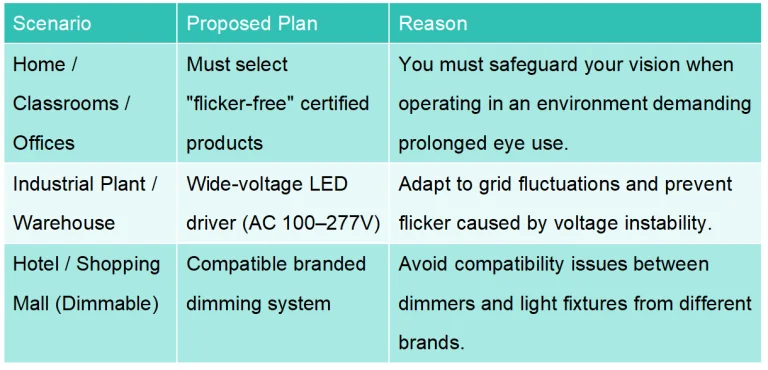
Please follow the below recommendations when selecting and installing LED lighting fixtures:
Choosing Professionalism Is Choosing the Future

Flicker is the “silent killer” in the LED industry, a true benchmark of a manufacturer’s technical capabilities.
We firmly uphold the principle of “optoelectronic quality first” and reject low-cost, inferior RC (resistor-capacitor) step-down solutions. Choosing our products is a commitment to end-users’ health, a robust safeguard to reduce after-sales disputes and boost the brand value.
Should you need specific flicker parameter data (including SVM values or modulation depth) for any of our products, please do not hesitate to contact our sales team for detailed test reports.