
Why Classroom Lighting Is a Compliance Decision, Not a Purchase Order?
For school procurement and facilities managers, upgrading classroom lighting is never merely a matter of replacing light fixtures; instead, it constitutes a complex balancing act encompassing compliance with visual health standards, financial audit and risk control, and long-term operational costs. Against the backdrop of increasingly stringent international mandatory standards and the full enforcement of myopia prevention requirements for children and adolescents (such as EN 62471 and EN 12464), selecting a lighting partner with both in-depth expertise in these standards and proven on-site implementation capabilities is critical for schools to avoid inspection failure risks.
How to Verify a Certified LED Classroom Lighting Manufacturer?
As a professional LED manufacturer with ISO9001 certification and globally recognized credentials including CE, CCC and RoHS, Dohe Lighting transcended the superficial criterion of “adequate brightness” when executing classroom lighting upgrades. Instead, the company integrated mandatory national standards, international photobiological safety protocols and on-campus practical realities to establish a measurable, auditable and traceable standard for the selection and installation of eye-protective lighting.
I. Safety Baseline: Dual Compliance with EN 62471 and GB 40070 Ensures Zero Blue Light Risk
Classrooms are settings where young people engage in intensive visual tasks for 6
–8 hours daily, rendering photobiological safety an uncompromising bottom line. In developing its eye-care lighting solutions, Dohe Lighting strictly adheres to the IEC/EN 62471 standard (*Photobiological Safety of Lamps and Lamp Systems*) for optical design and testing. This ensures consistent compliance with the RG0 classification (Exempt Group/No Hazard), effectively eliminating at the source the risk of photochemical damage to children’s developing retinas posed by high-energy, short-wavelength blue light.
At the same time, the lamps should fully meet mandatory domestic market access requirements:
• They should comply with the explicit provisions of GB 40070-2021, which stipulate that general classroom lighting fixtures must be classified as RG0 (Exempt Group) for blue light hazards;
• The entire educational lighting product line has obtained mandatory national CCC certification, eliminating any false claims of safety ratings.
In Dohe’s solutions, “RG0” is not merely a marketing slogan, it is a strict technical benchmark verified by CMA/CNAS-accredited third-party testing reports, which must accompany every batch of fixtures leaving the factory.
II. Light Quality: From Ra≥80 to Full-Spectrum High Color Rendering—Restoring True Visual Reality
Common flaws of low-quality LEDs, including color distortion, poor visibility of red ink, and color shifts in teaching materials, originate from insufficient Color Rendering Index (CRI) and R9 (saturated red) values. Tailored for classroom settings, Dohe Lighting has upgraded light quality parameters to exceed both national standards and the recommendations of EN 12464-1 (*Lighting of Indoor Workplaces*):
• General Color Rendering Index (Ra) ≥ 90 (far exceeding the national baseline of Ra ≥ 80), ensuring accurate reproduction of subtle color gradations;
• Special Color Rendering Index (R9) > 50 (even >90 in some cases), resolving the prevalent “poor red rendering” issue of traditional LEDs and meeting the requirements of color-critical activities such as art classes and laboratory experiments;
• Correlated Color Temperature (CCT) fixed within the range of 3300K to 5000K(Recommend: 5000K for classrooms and offices during the day; 4000K for a relaxed home ambience in the evening), strictly complying with the ranges specified in GB 40070 and EN 12464-1. It avoids neural overstimulation and visual fatigue caused by cool white light (>5500K), while maintaining strict color tolerance control (SDCM ≤ 3–5) to ensure highly consistent lighting across all classrooms in a school.
This high-CRI, full-spectrum lighting solution effectively replicates the quality of natural sunlight at 10:00 AM, thereby reducing the strain on ciliary muscles caused by frequent visual adjustments.
III. Glare Control and Illuminance: Eliminating “Blinding Blackboard Reflections” with UGR≤16 and 300/500 lx
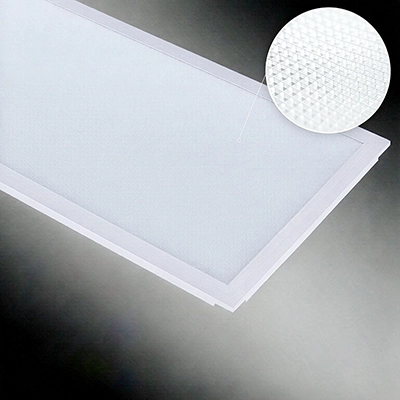
Glare poses a major threat to students’ vision when they look up at the blackboard. Rejecting low-end, open flat panel fixtures, Dohe Lighting adopts secondary optical designs—including micro-prismatic grids and deep-recessed anti-glare structures—to strictly control the Unified Glare Rating (UGR) of its classroom eye-protection lights at ≤16. The performance surpasses the national standard (GB 7793: ≤19) and meets the recommended requirement of EN 12464-1 (UGR <16 for spaces requiring precise visual tasks), effectively eliminating both the discomfort of direct glare and distracting blackboard reflections.
In terms of illuminance and uniformity, Dohe calibrates its systems in compliance with both GB 7793-2010 and EN 12464-1 standards:
• Desk surfaces: Maintain an average illuminance of ≥300 lx and illuminance uniformity of ≥0.7;
• Blackboard surfaces: Maintain a vertical illuminance of ≥500 lx and illuminance uniformity of ≥0.8;
Prior to installation, lighting layouts are simulated via DIALux to avoid abrupt contrasts—such as bright spots directly under lights versus dark corners—thereby reducing cumulative eye fatigue caused by frequent pupillary constriction.
IV. Flicker and Energy Efficiency: Protecting “Invisible Health” Through IEEE 1789 and ERP Standards
Naked-eye invisible flicker is a hidden trigger for headaches, impaired concentration, and progressive myopia deterioration. For its entire educational lighting product range, Dohe Lighting adopts high-power-factor (PF ≥ 0.95) constant-current drivers and active APFC flicker-free driver ICs to eliminate current ripple at the circuit level:
• Flicker depth far surpasses the ≤0.08% requirement specified in GB 40070;
• Stroboscopic Visibility Measure (SVM) ≤ 0.4 ( refer to the low-risk range defined in IEEE Std 1789-2015 and the strict SVM ≤ 1.0 threshold set by EU ERP Directive 2019/2020, delivering truly “flicker-free, healthy lighting.”
In addition, Dohe luminaires achieve an efficacy of ≥85–100 lm/W, complying with both the EU’s ERP minimum energy efficiency thresholds and domestic “Green Campus” energy-saving standards. While reducing campus lighting power density to ≤9 W/m², these fixtures boast a lifespan of over 30,000 hours with stable lumen maintenance, thereby minimizing the school’s total lifecycle operation and maintenance costs.
V. Dohe Lighting’s End-to-End Implementation Solution for Schools
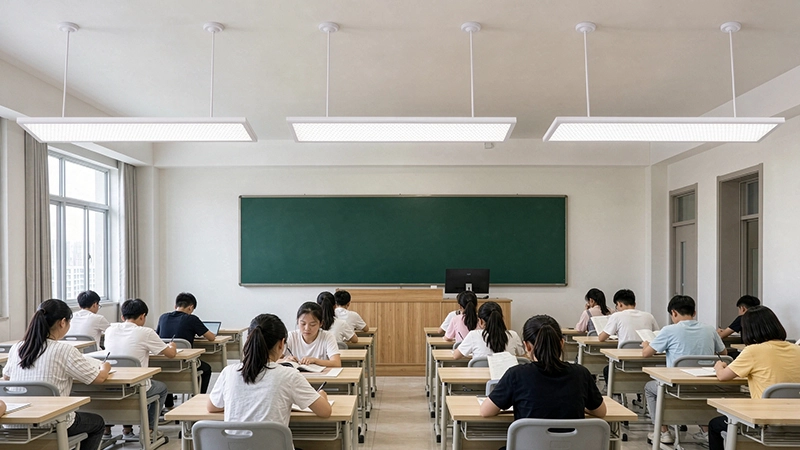
Standards remain no more than theoretical propositions until translated into successful practice. For classroom eye-protection lighting retrofits, Dohe Lighting adopts a rigorous five-step “Measure-Design-Supply-Install-Verify” workflow to guarantee quality and performance:
1.
Site Survey and Lighting Simulation: Prior to installation, DIALux software is utilized to produce illuminance simulation reports, taking into account variables including ceiling height, beam layout, and window orientation;
2.
Parameter Benchmarking and Sample Sealing: Core specifications—such as RG0 (exempt risk group), Ra ≥ 90, UGR ≤ 16, and SVM ≤ 0.4—are formalized in the technical agreement, with samples sealed and jointly confirmed by all three parties;
3.
Smart System Integration: Optional IoT control modules support constant illuminance sensing and scenario-based switching (e.g., for lectures, self-study, or projection), striking a balance between energy efficiency and teaching convenience;
4.
Standardized Installation: Fully sealed fixtures with an IP40+ dust- and insect-proof rating are deployed, paired with a one-stop service encompassing removal of old fixtures, wiring inspection, calibration of new fixtures, and site cleaning;
5.
Third-Party Blind Testing and Acceptance: Upon project completion, the company arranges on-site spot checks conducted by a CMA-accredited agency commissioned by the school (using the 9-point or 36-point grid method), with the resulting data reports serving as the basis for final settlement.
Standards-Guided, Committed to Vision Health
Classroom lighting upgrades essentially forge a protective net—interwoven with international photobiological safety standards (EN 62471), European high-quality lighting specifications (EN 12464-1), and mandatory domestic myopia prevention and control benchmarks (GB 40070, GB 7793)—to safeguard children’s visual health.
As a manufacturer with an integrated R&D department, production and testing facilities, Dohe Lighting delivers value beyond merely supplying “certified luminaires”; its core contribution lies in empowering schools to translate abstract technical parameters into tangible, classroom-specific lighting environments—marked by stability, softness, and freedom from glare or flicker. When tender specifications cease to be mere “word games” and acceptance data stands up to rigorous audits and parental scrutiny, the true professional standard of educational lighting upgrades is achieved.
Appendix: Dohe Lighting Classroom Eye-Protection Light–Key Benchmark Parameters (Reference for School Acceptance Inspection)
•Blue Light Hazard: EN 62471 / GB 40070 → RG0 (Exempt Group)
•Color Rendering: EN 12464-1 / High-Standard Recommendation → Ra≥90, R9 > 50
•Color Temperature: GB 40070 / EN 12464-1 → 3300K–5000K
•Glare: GB 7793 / Recommended Optimization → UGR≤16
•Illuminance: GB 7793 → Desktop≥300 lx (U₀≥ 0.7), Blackboard ≥500 lx (U₀≥0.8)
•Flicker: IEEE 1789 / ERP → SVM≤0.4; Modulation depth well below 0.08%
•Luminous Efficacy & Lifespan: ERP / National Standards → ≥85 lm/W, L70 ≥30,000h
•Safety Certifications: Full coverage of CCC / CE / ETL / RoHS